Beyond the City Limits: How Aichi's Autonomous Pioneers Are Quietly Conquering Rural America First
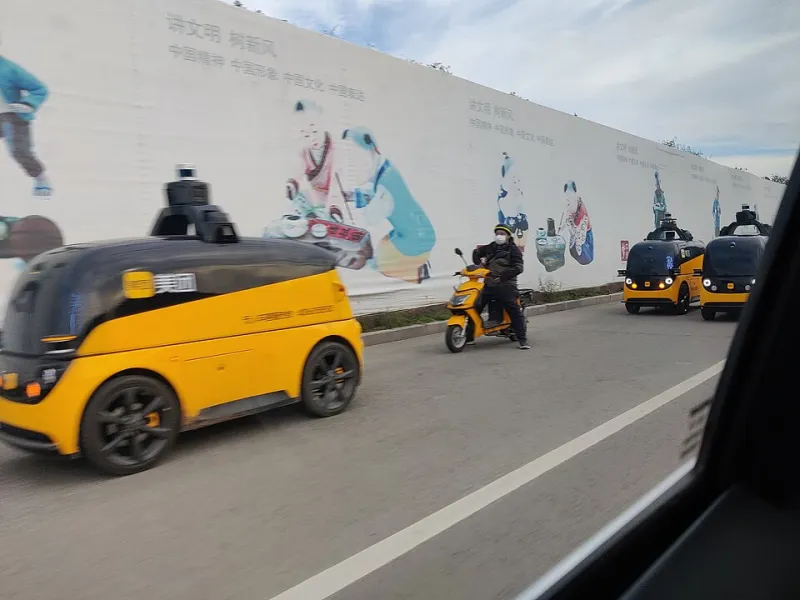
Photo: Anonymousfox36, CC BY-SA 4.0, via Wikimedia Commons
Drive forty minutes east of Columbus, Ohio, and the landscape changes in ways that autonomous vehicle engineers find either terrifying or exhilarating, depending on their background. The road markings thin out. GPS signals occasionally stutter beneath dense tree canopy. Farm equipment crosses at unmarked intersections. Broadband connectivity, the assumed backbone of most connected-vehicle architectures, becomes intermittent at best.
For most of the American autonomous vehicle industry, this is the problem to be solved after the easy problems—urban navigation, highway lane-keeping, structured parking—are already conquered. For a growing cohort of Aichi-based startups and their corporate partners, it is the problem to be solved first.
The Strategic Logic of Starting Small
The decision to target rural and exurban American markets is not, for these companies, a consolation prize. It is a deliberate strategic calculation rooted in a clear-eyed reading of where the regulatory and competitive landscape is least obstructed.
Urban autonomous vehicle deployment in the United States has become extraordinarily expensive and politically complicated. San Francisco's high-profile regulatory battles involving Waymo and the now-suspended Cruise operations demonstrated that city governments, emboldened by public safety concerns and media scrutiny, can impose operational restrictions that effectively neutralize the business case for dense urban deployment. Insurance requirements in major metropolitan areas are escalating. And the competitive field—Waymo, Amazon's Zoox, Motional, and a dozen smaller players—is crowded to the point of margin destruction.
Rural America presents a structurally different picture. Regulatory oversight at the county and township level is less sophisticated and, in many cases, actively welcoming of technology that promises economic benefit to underserved communities. Traffic density is low, reducing both the complexity of navigation and the severity of potential incidents. And critically, the populations most in need of autonomous mobility and logistics solutions—elderly residents without access to reliable transportation, small agricultural businesses dependent on supply chain efficiency, rural healthcare networks struggling with last-mile delivery—are concentrated precisely in these markets.
Aichi Startups Finding Their Footing in the Midwest and South
Several companies with deep roots in Aichi Prefecture's automotive ecosystem have moved from pilot programs to operational deployments in rural American corridors over the past eighteen months.
Tier IV, a Toyota-affiliated autonomous software company headquartered in Tokyo with significant R&D operations in Aichi, has been running a logistics pilot in partnership with a regional grocery cooperative serving rural communities across southern Indiana. The program, which uses Level 4 autonomous delivery vehicles on a fixed route network connecting distribution hubs to small-town pickup points, completed over 4,000 successful deliveries in its first operational year without a reportable safety incident. The route network was specifically designed to avoid the highway exposure and complex intersection scenarios that challenge urban deployments—a deliberate constraint that, paradoxically, accelerated the path to unsupervised operation.
Separately, Aisin, the Aichi-based automotive components giant that has been aggressively diversifying into mobility services, has partnered with a rural transit authority in western Kentucky to deploy a small fleet of autonomous shuttle vehicles serving the fixed-route connection between a regional medical center and outlying residential communities. The service addresses a documented transportation gap that has contributed to missed medical appointments and preventable health deteriorations among elderly residents—a use case with a compelling social argument that has smoothed the path through local regulatory review considerably.
Why Sparse Infrastructure Is Actually an Advantage
The counterintuitive insight driving Aichi's rural-first strategy is that the infrastructure limitations of rural America—the very conditions that make these markets unattractive to urban-focused AV developers—are, under the right operational design, genuine advantages.
Fixed-route operation on low-traffic roads with predictable patterns allows Aichi-developed systems to accumulate high-confidence operational data far more rapidly than mixed-traffic urban environments permit. A vehicle completing the same twelve-mile rural route twenty times per day is generating training data with a consistency and repeatability that an urban vehicle navigating unpredictable pedestrian flows and construction detours simply cannot match. The variance is lower. The edge-case frequency is lower. And the consequence of edge cases, when they do occur, is lower—because the surrounding traffic density that transforms an urban sensor failure into a multi-vehicle incident simply does not exist.
This operational logic maps directly onto the validation philosophy that Aichi manufacturers have applied to hardware development for decades. Controlled conditions, high repetition, incremental expansion of the operational design domain. It is, in essence, monozukuri applied to deployment strategy.
The Data Advantage and What Comes Next
The operational data being accumulated through these rural deployments is not merely useful for refining the systems currently in the field. It is building a foundation for the more complex deployments that will follow.
Aichi companies operating in rural America are collecting granular performance data on how their sensor arrays handle degraded road markings, how their navigation systems adapt to unsigned intersections, and how their vehicle platforms respond to infrastructure conditions—frost heaves, unpaved shoulders, inconsistent signage—that urban-optimized systems have rarely encountered. This data, fed back into development pipelines at Aichi facilities, is producing system refinements that will eventually make urban deployment more robust.
The strategic sequence, as several Aichi executives have described it in industry forums, is deliberate: prove the technology in the market that will accept it first, accumulate the operational record that regulators and insurers require, and use that record to accelerate entry into the larger urban markets that remain the long-term prize.
For rural American communities, the near-term benefits are tangible and immediate: logistics services that reduce delivery costs, mobility options for populations that currently have none, and a level of technological investment that has historically flowed exclusively to coastal urban centers. For Aichi's autonomous vehicle ecosystem, the calculation is equally clear.
The last-mile revolution, it turns out, was never going to start in Manhattan or Silicon Valley. It was always going to start somewhere quieter—somewhere with straight roads, patient regulators, and communities willing to give new technology the time it needs to prove itself. In 2025, that somewhere is increasingly rural America, and the companies finding their footing there first are building in Aichi.