The Depot as a Machine: Inside Aichi's Round-the-Clock Bases Where Driverless Fleets Go to Heal
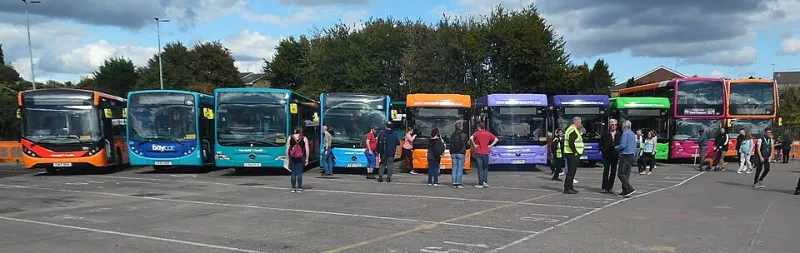
Photo: David Hillas, CC BY-SA 2.0, via Wikimedia Commons
For most of the twentieth century, the bus depot was the unglamorous end of the transit world — a place for oil changes, brake jobs, and the slow accumulation of grime. In Aichi Prefecture, that building has been reconceived entirely. Today, the region's autonomous fleet depots function less like garages and more like semiconductor fabs: climate-controlled, sensor-saturated, and operating on schedules measured in minutes rather than shifts.
The transformation was not optional. When a fleet has no drivers, it also has no one to notice a soft tire, a misaligned lidar housing, or a calibration drifting out of tolerance. The depot itself had to become the mechanic.
Diagnostics Before the Door Opens
The most striking feature of Aichi's modern depots is that vehicle inspection begins before the vehicle arrives. Every autonomous bus and shuttle in the region's core corridors streams telemetry continuously to its home base, so by the time a unit returns from an evening of service, technicians already know which wheel bearing is trending toward failure and which camera lens collected a film of road spray.
This changes the economics of maintenance profoundly. Rather than servicing vehicles on fixed intervals — the American habit, codified in decades of federal transit guidance — Aichi's operators service on condition. Parts arrive before the vehicle does. Work orders are generated by algorithms and confirmed by humans. The average dwell time for a routine check has reportedly fallen below what a conventional garage spends on a single brake inspection.
For American fleet managers watching labor costs climb and technician shortages deepen, the appeal is obvious. But the deeper lesson is architectural: Aichi treated the depot as a node in the network, not a parking lot with a garage attached.
The Robotic Middle Layer
Walk through one of the newer facilities outside Nagoya and the machinery is hard to miss. Overhead manipulators handle tire rotations. Automated undercarriage scanners photograph every bolt and weld against a digital reference model, flagging deviations to the tolerance of a fraction of a millimeter. Charging is largely robotic — vehicles dock themselves, and the depot's energy system schedules charging around both grid pricing and the next morning's dispatch plan.
Yet the robots are the least interesting part of the story. What makes these facilities work is the deliberate design of what Aichi's engineers call the "middle layer" — the interface between automated systems and the human workforce that remains essential. Every robotic process has a defined failure mode, and every failure mode has a human procedure attached to it. The depot is designed around the assumption that automation will sometimes be wrong, and that the people on the floor need the tools, the authority, and the training to overrule it quickly.
Retraining, Not Replacing
That philosophy extends to labor. Aichi's depot workforce is heavily drawn from veteran mechanics — people who spent decades diagnosing diesel engines by sound and feel. Rather than discarding that expertise, operators mapped it: experienced technicians co-develop the diagnostic thresholds the software uses, and they serve as the final arbiters when automated inspection and human judgment disagree.
The retraining pipeline is formal. Technicians rotate through certification modules covering high-voltage systems, sensor recalibration, and software rollback procedures. Crucially, the programs are run in partnership with regional vocational institutions, creating a steady pipeline of workers who enter the field expecting to service machines that drive themselves.
This is where American operators face their steepest climb. Transit agencies from Seattle to Miami are only beginning to define what an autonomous fleet technician even is, and community colleges have yet to build curricula at scale. Aichi's experience suggests the answer is not fewer workers but differently skilled ones — and that the transition takes years of deliberate planning, not a procurement cycle.
What the Blueprint Means for the United States
The infrastructure gap is real. The United States has thousands of depots built around the assumption of a driver in every vehicle: driver lounges, sign-in stations, manual fueling bays. Converting even a handful to Aichi's standard — self-docking chargers, robotic inspection lanes, telemetry-linked parts logistics — requires capital that most agencies have never budgeted and zoning that most municipalities have never contemplated.
There are early signals of movement. Several American logistics operators running autonomous middle-mile routes have begun specifying depot requirements in their vehicle procurement contracts, effectively forcing the ecosystem to think about ground facilities alongside the vehicles themselves. A handful of transit agencies in sunbelt states have commissioned feasibility studies for "smart base" retrofits, citing Aichi's depots explicitly.
The policy question is equally pressing. Federal transit funding formulas, state garage-inspection codes, and local land-use rules all predate the driverless depot. Aichi's regional government smoothed the path by treating these facilities as critical mobility infrastructure — eligible for the same streamlined approvals as road widening or rail maintenance yards. No equivalent designation exists in most US jurisdictions.
The Facility Nobody Planned For
The uncomfortable truth about autonomous vehicle deployment — in Japan, in America, everywhere — is that the vehicles get the attention while the buildings get the leftovers. Aichi inverted that. Its depots were designed alongside the fleets they serve, with the same rigor, the same funding, and the same engineering talent.
The result is a system where a driverless bus can complete a full diagnostic, recharge, recalibrate, and return to service in the time it takes a conventional bus to queue for a fueling bay. Multiply that across a fleet and across a decade, and the depot stops being a cost center and becomes a competitive asset.
For American operators, the window to learn from Aichi's experience is open now — before the first large autonomous deployments make depot design a crisis rather than a choice. The garage that never sleeps is not a novelty. It is, increasingly, the price of admission.