Miles Into Money: The Quiet Data Economy Powering Aichi's Autonomous Fleets
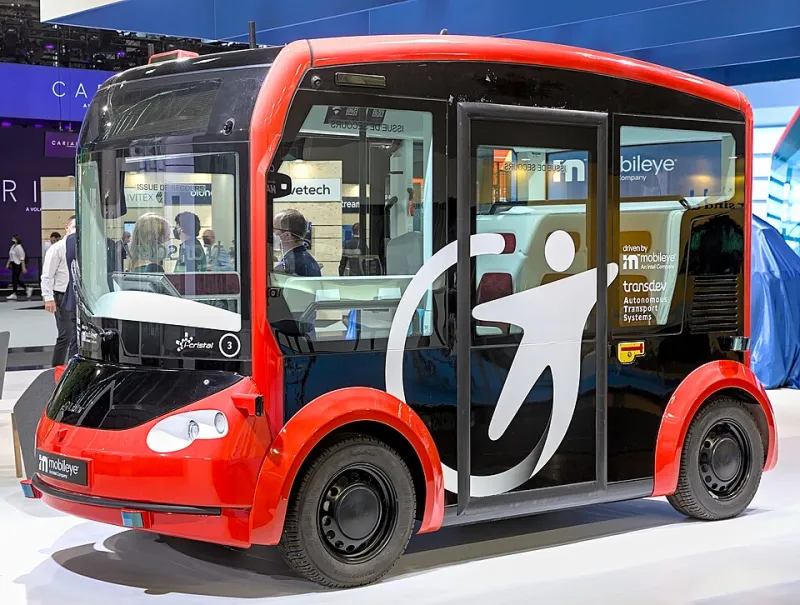
Photo: Alexander Migl, CC BY-SA 4.0, via Wikimedia Commons
The passenger steps off the autonomous shuttle in Nagoya's Nishi Ward without ever seeing the transaction that just took place. The ride may have cost a few hundred yen — or nothing at all. But the twelve minutes of sensor footage, lidar point clouds, pedestrian trajectory data, and edge-case annotations generated along the route are already flowing back into the region's mobility ecosystem, where they will make the next ride safer, and the one after that cheaper to operate.
This is the business model that few American observers have fully priced in. Aichi's autonomous deployments are not merely transportation pilots. They are, in effect, data acquisition programs wearing the costume of public transit.
The Flywheel Nobody Is Selling
American autonomous vehicle companies have long treated data as an internal asset — something to hoard, not monetize. Waymo accumulates miles in Phoenix and San Francisco; Cruise did the same in San Francisco before its operational collapse. The data stays in-house, feeding proprietary models, and the business case rests on eventually selling rides at scale.
Aichi's approach inverts this logic. Because the region's autonomous programs involve a dense web of interlocking players — established suppliers, municipal operators, university research labs, and a new generation of mobility startups — the data generated by any single deployment tends to circulate. A shuttle operated by one consortium feeds perception models used by another. A delivery robot's difficulty navigating a narrow shopping arcade in Toyota City becomes a shared lesson across the ecosystem.
The result is something economists might recognize as a network effect applied to physical infrastructure. Each new route added to the network increases the value of every existing route, because the operating environments overlap: the same monsoon-season rain, the same school-zone pedestrian patterns, the same delivery trucks double-parked outside Nagoya Station.
Why Density Beats Scale
Silicon Valley's instinct has always been to scale — more cities, more miles, more markets. But raw mileage is a blunt instrument. Ten million highway miles in the American Southwest teach a model relatively little about the chaotic, human-scaled environments where autonomy actually struggles.
Aichi's urban fabric is the opposite of blunt. Narrow streets without sidewalks, cyclists weaving between parked cars, elderly pedestrians crossing mid-block, and intersections where three generations of traffic engineering coexist awkwardly — these are exactly the scenarios that consume American AV developers' simulation budgets. Testing in Japan's dense environments means every kilometer produces a higher yield of rare and valuable edge cases.
In effect, Aichi's fleets are harvesting the most expensive data in the industry at commodity prices, simply by operating where the complexity already lives.
The Governance Question
What makes this flywheel politically durable — and exportable — is the governance scaffolding around it. Japan's framework for autonomous data collection, refined through the 2023 amendments to the Road Traffic Act and prefecture-level pilot agreements, establishes clear provenance for vehicle data. Passenger privacy is handled under APPI, Japan's personal information protection regime, with anonymization requirements that are, in several respects, stricter than comparable US state rules.
For American regulators, this offers both a template and a warning. The template: data-sharing consortia with defined access tiers can accelerate an entire regional industry without requiring any single company to surrender its crown jewels. The warning: the Federal Trade Commission and state attorneys general have grown increasingly aggressive about biometric and location data, and any US attempt to replicate the Aichi model would need privacy architecture baked in from day one, not retrofitted after the first scandal.
There is also a geopolitical dimension that Washington is unlikely to ignore. If Japanese mobility firms and their suppliers emerge from this decade holding the richest structured datasets for dense-urban autonomy, the data economy of self-driving vehicles could mirror the semiconductor dynamics of the last one — with export controls and data localization rules following close behind.
What It Means for the American Race
For US companies, the uncomfortable arithmetic is this: a competitor that monetizes data across a network will improve faster than one that monetizes data in isolation, even if the isolated player has more capital. Several American startups have begun experimenting with shared data trusts and cross-industry annotation pools, but nothing on the scale or formality of what is operating in Aichi today.
The lesson for American policymakers is not to subsidize more test miles. It is to build the legal and commercial plumbing that lets data move between firms at all — something the US has historically done poorly outside of agriculture and genomics.
The passenger in Nishi Ward walked away from that shuttle with nothing but a ride. The region walked away with an asset that compounds daily. Until American companies and regulators decide what a mile of autonomy is actually worth — and who gets to sell it — that compounding will continue on the other side of the Pacific.