Forged in the Storm: How Aichi's Brutal Weather Is Producing the World's Most Battle-Tested Autonomous Vehicles
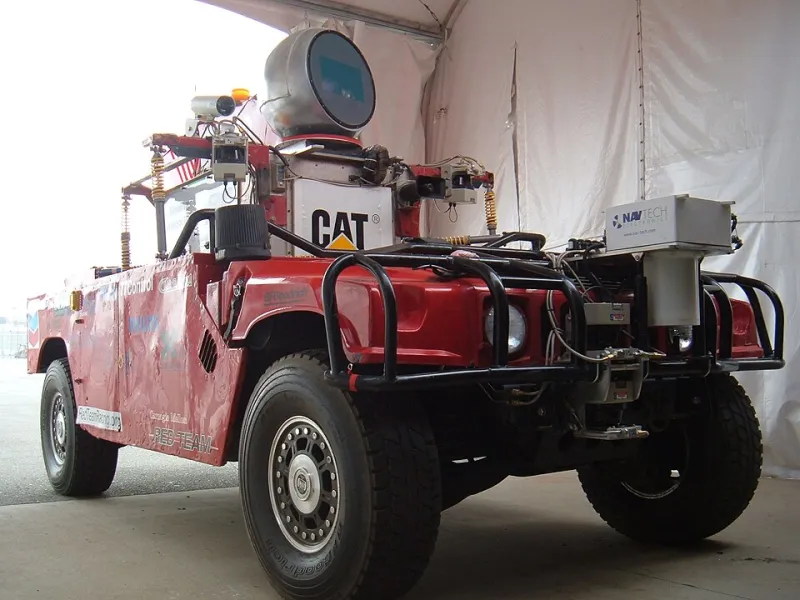
Photo: Dan Homerick, CC BY 2.0, via Wikimedia Commons
There is a well-worn assumption embedded in the history of autonomous vehicle development: that the best place to test a self-driving car is somewhere it rarely rains. California's perpetually clear skies made it the default proving ground for the industry's most ambitious names. Sensor arrays perform cleanly in dry air. Lane markings stay crisp and visible. Radar and LiDAR signals travel without interference. For years, that logic seemed unassailable.
Aichi Prefecture is dismantling it, one rainstorm at a time.
Positioned along Japan's Pacific coastline, Aichi experiences a climate that automotive engineers describe with a mix of professional respect and barely concealed frustration. Summer brings the tsuyu — Japan's extended rainy season — delivering weeks of sustained precipitation that turns urban roads into shallow rivers and reduces visibility to distances that render conventional sensor configurations effectively blind. Winter introduces a separate category of difficulty: freezing temperatures, occasional snowfall, and road surfaces coated in the kind of slick, semi-frozen precipitation that occupies the worst possible middle ground between rain and ice. Neither season is forgiving. Together, they constitute one of the most demanding real-world testing environments on the planet.
What Dry-Climate Testing Cannot Teach
The limitations of California-style testing became apparent not through catastrophic failure but through a quieter, more insidious problem: vehicles that performed flawlessly in San Jose or Mountain View began encountering edge cases the moment they were deployed in less accommodating environments. Rain-speckled camera lenses. LiDAR returns distorted by water droplets suspended in humid air. Road markings obscured by standing water or frost. These were not exotic scenarios — they were Tuesday mornings in most of the United States.
Aichi's developers were never afforded the luxury of ignoring these conditions. Operating in a region that serves as the manufacturing nucleus of Toyota, Denso, and dozens of tier-one suppliers, engineers here have been designing for adverse weather not as an afterthought but as a foundational parameter. The result is a generation of sensor fusion architectures and AI perception models that treat precipitation as a standard operating condition rather than an exceptional one.
Companies working within Aichi's expanding autonomous testing corridors — routes that stretch from the dense urban grid of Nagoya into the prefecture's more dispersed suburban and semi-rural zones — have developed multi-modal sensing approaches that compensate dynamically when any individual sensor type is compromised. When heavy rain degrades optical camera performance, radar-based systems carry greater weighting in the vehicle's decision framework. When accumulated road grime disrupts LiDAR point clouds, machine learning models trained on thousands of hours of degraded-condition data fill the interpretive gaps.
The Policy Framework Enabling Extreme Condition Testing
Aichi's ability to serve as a genuine all-weather testing ground is not purely a function of geography. The prefecture's regulatory environment has evolved in deliberate coordination with its industrial ambitions. Japan's national government designated Aichi as a priority zone for autonomous mobility experimentation under its Society 5.0 framework, and prefectural authorities have since extended that mandate to include testing permissions that are notably more accommodating than those available in most U.S. states.
Critically, Aichi's testing protocols explicitly require demonstration of performance across seasonal conditions. A vehicle seeking expanded operational permissions cannot simply validate its capabilities during optimal weather windows. It must document performance through the rainy season, through winter precipitation events, and across the temperature variance that separates Aichi's humid summers from its colder months. This regulatory insistence on comprehensive environmental validation has, somewhat counterintuitively, accelerated rather than impeded development — forcing companies to confront weather-related failure modes earlier in their testing cycles than they might otherwise choose to.
For American developers accustomed to negotiating testing frameworks on a state-by-state basis, the coherence of Aichi's policy approach represents a meaningful structural advantage. Several U.S.-based autonomous vehicle companies have established quiet testing partnerships with Aichi-based facilities, shipping prototype vehicles to Japan for precisely the kind of adversarial environmental exposure their domestic programs cannot easily replicate.
American Roads, Japanese Lessons
The implications for U.S. infrastructure and deployment planning are substantial. The American road network spans an extraordinary range of climatic conditions — from the perpetual overcast of the Pacific Northwest to the ice storms of the Midwest, the hurricane-season downpours of the Gulf Coast, and the high-altitude snowpack of mountain corridors. A self-driving vehicle system validated exclusively in California's Central Valley is, in a meaningful sense, validated for a narrow slice of the country it intends to serve.
Aichi's weather-hardened development methodology offers a different model. By treating adverse conditions as the test, rather than the exception, the region's engineers are producing systems with demonstrated resilience across a spectrum of environmental variables. The AI perception models being refined on Nagoya's rain-slicked expressways are, by necessity, more robust than those trained primarily on clear-sky data.
U.S. transportation planners and fleet operators paying attention to Aichi's 2025 testing outputs are beginning to incorporate weather-performance benchmarks into their procurement frameworks — asking not just whether a system can navigate a mapped route, but whether it can do so when that route is partially obscured by a November rainstorm.
The Competitive Advantage Hidden in Bad Weather
There is a certain irony in the fact that Aichi's most significant competitive advantage in the global autonomous vehicle race may be something no amount of engineering investment can manufacture: a climate that refuses to cooperate. Silicon Valley's sunshine, long considered an asset, is increasingly understood as a form of insulation from the conditions that autonomous systems must eventually master.
The vehicles being tested along Aichi's storm-battered corridors in 2025 are not simply accumulating mileage. They are accumulating the kind of adversarial experience that produces genuinely reliable systems — the kind that can be trusted not just when conditions are ideal, but when they are anything but. For an industry that has spent years promising transformative technology while quietly deferring the hardest problems, that distinction matters enormously.
Aichi is not waiting for better weather. It is building better vehicles because of the weather it already has.