Japan's $10 Billion Autonomous Corridor: What Aichi's 2025 Infrastructure Gamble Means for American Roads
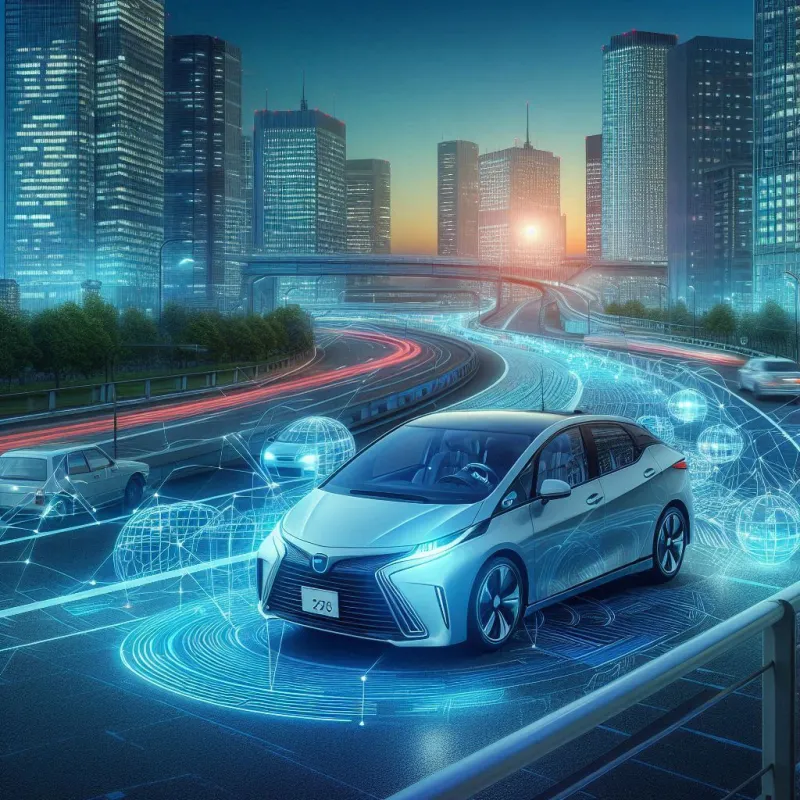
Photo: Japan highway autonomous vehicle smart infrastructure 2025, via eleauto.up.seesaa.net
When American engineers and urban planners think about the future of autonomous vehicles, they tend to look west — toward Silicon Valley campuses, Arizona test tracks, and the endless debate over federal regulation. Increasingly, however, the most consequential developments in self-driving technology are unfolding on the other side of the Pacific, in a densely populated Japanese prefecture that has quietly positioned itself as one of the world's most ambitious proving grounds for next-generation mobility.
Aichi Prefecture — long recognized as the heartland of Japan's automotive industry — is executing a sweeping infrastructure initiative valued at approximately $10 billion. Scheduled for phased activation throughout 2025, the project represents one of the largest coordinated investments in autonomous vehicle deployment infrastructure anywhere on the globe. For American stakeholders watching from afar, the scale and sophistication of what is being built in central Japan deserve serious attention.
The Architecture of an Integrated Testing Zone
Unlike the fragmented, city-by-city pilot programs that characterize much of the United States' approach to autonomous vehicle testing, Aichi's initiative is designed as a unified ecosystem. The corridor spans several hundred kilometers of roadway connecting major urban centers, industrial hubs, and logistics corridors across the prefecture. What distinguishes it architecturally is the degree to which the physical infrastructure and the digital layer have been engineered in tandem.
Embedded sensor arrays, high-density lidar reference markers, and vehicle-to-infrastructure (V2I) communication nodes have been installed at intervals precise enough to support centimeter-level positioning for autonomous platforms. Fiber-optic backbone networks running beneath the road surface feed real-time data to centralized operations centers, which monitor traffic flow, weather conditions, and vehicle behavior simultaneously. This is not a test track in the conventional sense — it is, in effect, a living laboratory operating at regional scale.
The Japanese government's Ministry of Land, Infrastructure, Transport and Tourism (MLIT) has provided substantial regulatory scaffolding for the project, streamlining the approval processes that have historically slowed autonomous vehicle deployment in densely populated areas. Aichi's prefectural government, working in close coordination with MLIT, has enacted local ordinances that allow higher levels of autonomy — including Level 4 operations in designated zones — without the patchwork of municipal permissions that complicate comparable efforts in American metros.
Public-Private Architecture: A Different Governance Model
One of the most instructive aspects of Aichi's corridor is its governance structure. Rather than relying on a single dominant technology company or a federal mandate, the project was assembled through a consortium model that brings together legacy automakers, tier-one suppliers, telecommunications carriers, academic institutions, and municipal governments under a shared operational framework.
Toyota, which maintains its global headquarters in Toyota City within Aichi, has been a central participant — contributing proprietary sensor fusion technology and fleet data accumulated from decades of hybrid and connected-vehicle programs. Yet the consortium deliberately prevents any single entity from controlling the corridor's data architecture, a design choice that encourages interoperability and reduces the competitive friction that has stalled collaborative autonomous vehicle projects in the United States.
By contrast, the American model has largely relied on private companies — Waymo, Cruise, Aurora, and others — to develop and deploy autonomous systems within regulatory frameworks that vary dramatically from state to state. The result has been rapid technological innovation in isolated pockets, but limited systemic integration. Aichi's approach suggests that treating autonomous mobility as shared infrastructure, rather than proprietary product, may accelerate real-world deployment significantly.
Technological Breakthroughs Emerging From the Corridor
Several specific innovations incubated within the Aichi ecosystem are worth highlighting for their potential applicability to American transportation challenges.
First, Aichi researchers have made notable advances in adverse-weather autonomy. Japan's varied climate — encompassing heavy snowfall in northern regions and typhoon-season rainfall — has compelled engineers to develop sensor redundancy architectures and predictive path-planning algorithms that perform reliably under conditions that frequently degrade lidar and camera performance. American autonomous vehicle programs operating primarily in temperate Sun Belt environments have historically underinvested in this area, a gap that becomes apparent when deployments expand to northern states.
Second, the corridor has served as a testbed for mixed-traffic integration — the challenge of operating autonomous platforms alongside conventional human-driven vehicles, cyclists, and pedestrians in real urban conditions. Aichi's dense urban fabric, with its narrow residential streets and complex intersection geometries, has forced development of more conservative and socially adaptive driving behaviors than those optimized for wide American arterials.
Third, the logistics dimension of the project is generating insights relevant to the American freight industry. Autonomous heavy-goods vehicles operating on designated corridor segments are being evaluated for platooning efficiency, port-to-distribution-center cycle times, and driver-assist transition protocols — data points that American trucking operators and e-commerce companies are monitoring carefully.
Lessons for American Transportation Policy
The United States is not without its own ambitious autonomous vehicle initiatives. The Infrastructure Investment and Jobs Act of 2021 allocated funding for intelligent transportation systems, and the Department of Transportation has published updated autonomous vehicle guidance documents in recent years. Nevertheless, American policy remains structurally reactive — responding to industry developments rather than proactively building the conditions for deployment.
Aichi's model offers three concrete lessons for American policymakers. First, infrastructure investment must precede widespread autonomous deployment, not follow it. The corridor's embedded sensing and communications layer was built before autonomous vehicles began operating on it — a sequencing that American cities, constrained by existing road budgets and political cycles, have struggled to replicate.
Second, regulatory harmonization at the state level is urgently needed. Japan's national framework, adapted at the prefectural level, provides a coherent legal environment that American states operating under divergent rules cannot currently match. Federal leadership, rather than deference to a fifty-state patchwork, would meaningfully accelerate domestic deployment timelines.
Third, data governance matters as much as technology. Aichi's consortium structure, with its emphasis on interoperability and shared data standards, has avoided the proprietary silos that fragment American autonomous vehicle development. Establishing national data-sharing frameworks — with appropriate privacy protections — could unlock collaboration between American automakers and technology companies that currently treat their datasets as competitive moats.
What Comes Next
As Aichi's corridor moves from construction into active operation throughout 2025, the global autonomous vehicle community will be watching its performance metrics with considerable interest. American automakers with Japanese partnerships — including those embedded within Toyota's extensive supplier network — are already receiving technical briefings on corridor findings. Several US cities with large Japanese-American business communities, including Los Angeles and Detroit, have initiated preliminary conversations about knowledge-transfer programs.
The corridor will not transplant directly onto American soil. Land use patterns, liability law, labor dynamics, and public attitudes toward automation differ substantially between the two countries. But the underlying insight driving Aichi's $10 billion commitment — that autonomous mobility requires systemic infrastructure investment, not just brilliant software — is one that American transportation leaders would do well to absorb before the gap between the two nations' deployment timelines grows any wider.